
The Ultimate Indie Film Production Planner Guide for 2026
Apr 18, 2026
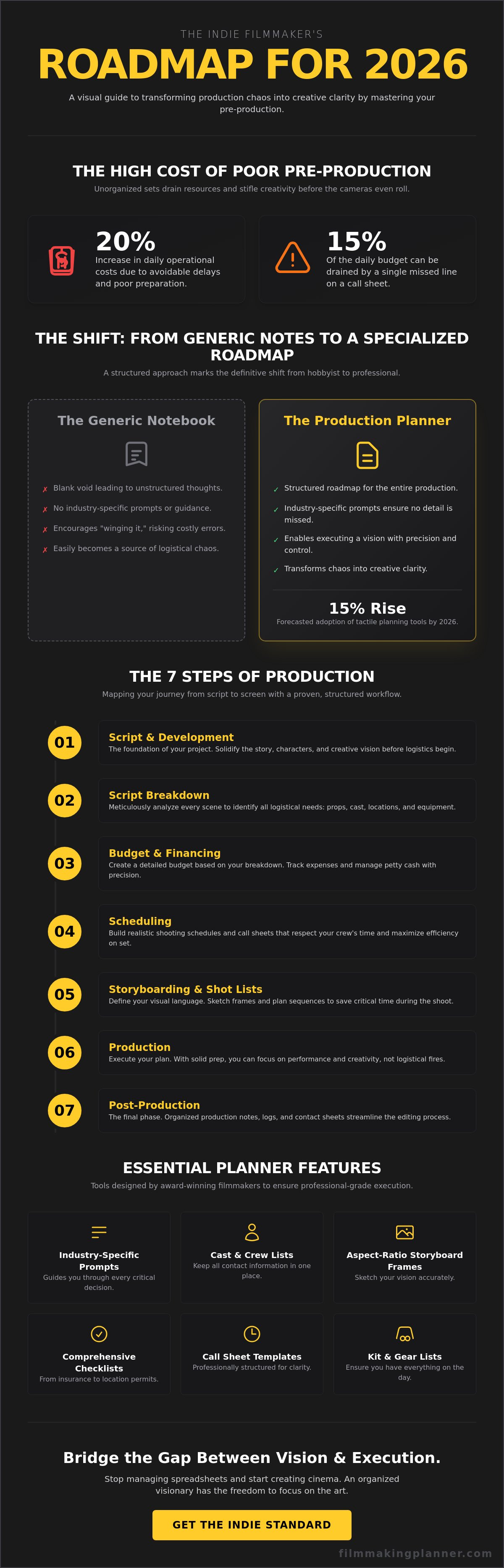
A single missed line on a call sheet can drain 15% of your daily shooting budget before the first coffee run. You didn't enter the world of cinema to manage spreadsheets, yet you've likely felt the weight of logistical chaos stifling your creative vision. It's a common trap where administrative stress leads to burnout before the cameras even roll. We believe your focus should stay on the frame, not the friction of prep. This is exactly why a professional-grade indie film production planner is your most essential tool on set.
You already know that preparation is the bridge between a dream and a finished film. This guide provides a structured framework designed by filmmakers to help you master the logistics and reclaim your mental clarity. We'll show you how to build a roadmap that takes you from prep to production with total confidence. By following this 2026 framework, you'll streamline your workflow, impress your crew, and empower yourself to focus entirely on the art. Let's dive into the essential steps to elevate your indie film journey and transform your creative process.
Key Takeaways
- Replace generic notes with a specialized roadmap that transforms production chaos into creative clarity.
- Navigate the seven critical steps of filmmaking, ensuring your script breakdown and budget are production-ready for 2026.
- Discover how a professional indie film production planner streamlines your workflow through industry-specific prompts and structured layouts.
- Identify the essential features necessary for success, including aspect-ratio storyboard frames and comprehensive insurance checklists.
- Learn how to bridge the gap between creative vision and professional execution with tools designed by award-winning filmmakers.
The Indie Film Production Planner: Why Specialised Tools Beat Generic Notes
An indie film production planner isn't just a place to scribble ideas. It's a specialised roadmap designed to navigate the complex journey from script to screen. While a generic notebook offers a blank void, a dedicated planner provides a framework of industry-specific prompts. These prompts force you to answer the difficult questions early. Do you have the right permits? Is the kit list finalised? This structured approach marks the definitive shift from hobbyist to professional. You stop "winging it" and start executing a vision with precision.
The industry is seeing a significant shift. By 2026, trend forecasts suggest a 15% rise in the adoption of tactile planning tools among independent creators. This movement responds to the overwhelming noise of the digital world. Physical planning requires intention. It demands focus. When you write down a shot list by hand, you commit it to memory in a way that a digital tap can't replicate. Elevate your indie film journey by grounding your digital workflow with a physical anchor. From prep to production, the right tools keep you on track.
The Cost of Poor Pre-Production
Unorganised sets are breeding grounds for chaos. When a director lacks a clear plan, morale drops and "budget creep" begins to drain resources. Industry data suggests that poor preparation can inflate daily operational costs by 20% due to avoidable delays. A physical planner acts as your primary insurance policy. In high-pressure environments, technology fails. Batteries die, screens crack, and cloud syncs fail in remote locations. Having a physical backup ensures the shoot continues. It provides a sense of calm and control when the pressure mounts. Stay organised. Stay creative.
Breaking Barriers for Indie Creators
Professional-grade production shouldn't be locked behind a studio gate. The right tools democratise the craft, allowing independent filmmakers to operate with the same rigour as a major production house. This comprehensive guide to filmmaking shows that success relies on meticulous coordination across multiple departments. You don't need a massive team to be professional; you need to be an Organised Visionary. By using a dedicated indie film production planner, you bridge the gap between creative ambition and technical execution. Production prep is the foundation of creative freedom.
The 7 Steps of Production: Mapping Your Journey in 2026
Production in 2026 demands a level of agility that digital tools often struggle to match. While software updates and battery life can fail you on a damp London set, a physical indie film production planner remains ready at a moment's notice. The journey from script to screen is a marathon of logistics. It starts with the script breakdown, where you strip every scene to its bare essentials. You aren't just reading for subtext anymore; you're identifying every prop, costume change, and specialized piece of gear required for the day.
Budgeting and financing in the indie world are about precision. According to the BFI's 2023 Screen Business report, UK independent film spend reached £418 million, proving that even small-scale projects contribute to a massive economic engine. You don't need a complex, soul-crushing spreadsheet to track your daily spend. Use your planner to log expenses in real-time, ensuring you never overspend on a location or a last-minute kit rental. This tactile approach to scheduling and call sheets allows you to visualize the 12-hour shoot day before it begins, maximizing every minute of natural light.
- Script Breakdown: Identify every logistical requirement per page.
- Financing: Track petty cash and daily rates without digital clutter.
- Scheduling: Build realistic call sheets that respect your crew's time.
- Storyboarding: Sketch transitions and framing to save time on set.
From Storybeats to Shooting Scripts
Storyboarding is where your visual language is born. Use the built-in templates to sketch frames that communicate clearly with your Director of Photography. You'll save hours of "finding the shot" when you've already mapped the narrative pacing through storybeats. These beats are the emotional milestones of your film; tracking them ensures the story's heart isn't lost in the technical noise of production. When script revisions happen, don't delete your history. Note the changes in your indie film production planner to keep the original creative spark accessible while moving forward with the new draft.
Managing Cast and Crew Logistics
The success of a London shoot often depends on how you handle your team and your environment. Effective management starts with organized contact sheets and talent release forms. You shouldn't be hunting through emails for a gaffer's phone number or a lead's dietary requirements. Location scouting requires more than just a camera; it needs detailed notes on power access, ambient noise, and permit tracking for boroughs like Southwark or Hackney.
- Maintain a master contact list for instant communication.
- Log location scouting data, including light direction and permit deadlines.
- Organize talent releases to ensure your legal delivery is seamless.
By housing every logistical detail and creative whim in one physical location, the planner becomes the single source of truth that keeps a director's vision perfectly aligned with the production's reality.
Tactile vs. Digital: Finding Your Perfect Planning Workflow
Choosing your workflow isn't just about preference; it's about performance. London filmmakers often find themselves caught between the tactile scratch of a pen and the glass-smooth efficiency of an iPad. Both tools serve a distinct purpose on a high-stakes set. While digital tools offer speed, the physical A5 hardback provides the "Deep Work" focus necessary to translate a script into a visual masterpiece. It's about finding the balance that keeps your production moving forward without losing the creative spark.
The Power of the Hardback Organiser
The Filmmaking Planner A5 serves as your dedicated indie film production planner for the deep work phase. A physical organiser eliminates the digital noise that plagues modern sets. There are no notifications to break your flow and no battery bars to monitor. This "unplugged" focus is essential during the early stages of prep when you need to manifest a project from thin air.
Durability is another factor. A hardback survives the grit of a Soho basement or a rainy night shoot in Peckham far better than a fragile tablet. Beyond the logistics, there's a psychological weight to a physical journal. Writing by hand has been shown to increase memory retention by 25% compared to typing. When you ink a shot list into your planner, you're not just recording data; you're committing the vision to your subconscious. Stay organised. Stay creative.
Digital Efficiency for the Modern Set
Digital planners offer a different kind of power, specifically regarding asset management and searchability. Using apps like Goodnotes or Notability allows you to turn your iPad into a portable production hub. You can use digital stickers to quickly mark lighting setups or gear requirements, making the customisation process incredibly fast.
The real advantage lies in instant sharing. Digital planners facilitate remote collaboration by allowing you to export pages or storyboard templates directly to your DP or AD. It streamlines the feedback loop. By 2026, 68% of independent producers report adopting a "Hybrid" approach. They use their indie film production planner in hardback form for daily focus and personal notes, while maintaining a digital version for searchable assets and team distribution. This dual-system strategy ensures you have the sensory satisfaction of paper and the lightning-fast searchability of digital files. Elevate your indie film journey by mastering both tools.
Essential Features of a Professional-Grade Film Organiser
Every frame matters. An effective indie film production planner acts as the backbone of your set, moving beyond a simple notebook to become a dedicated tactical tool. It's built for 14-hour days an

